Jung
Jung’s ideas about persona, shadow and projection shape questions about the roles we inhabit, what we leave out of our self-image, and the meanings we give other people. The imagery leaves room for several interpretations.
Draw a card. See where it goes.
72 illustrated questions about work, love, desire, belonging and power.
Put a few cards on the table. Say what one brings to mind. Hear what everyone else sees in it.
Currently taking shape. Come have a look.
Try a question, right here
Read it aloud. Answer to yourself.
Or leave it on the table for later.
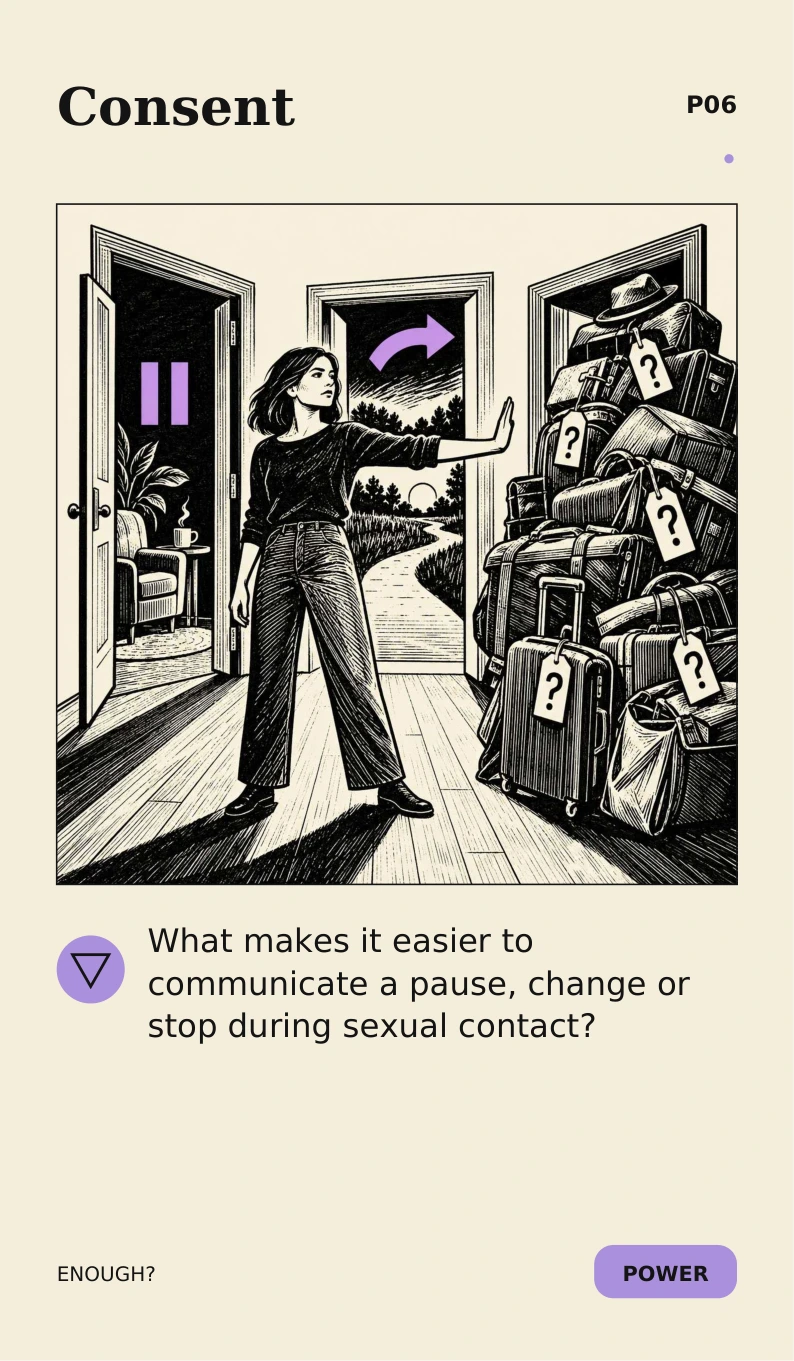
What makes it easier to communicate a pause, change or stop during sexual contact?
Questions from the final deck. There’s no correct answer.
A look inside
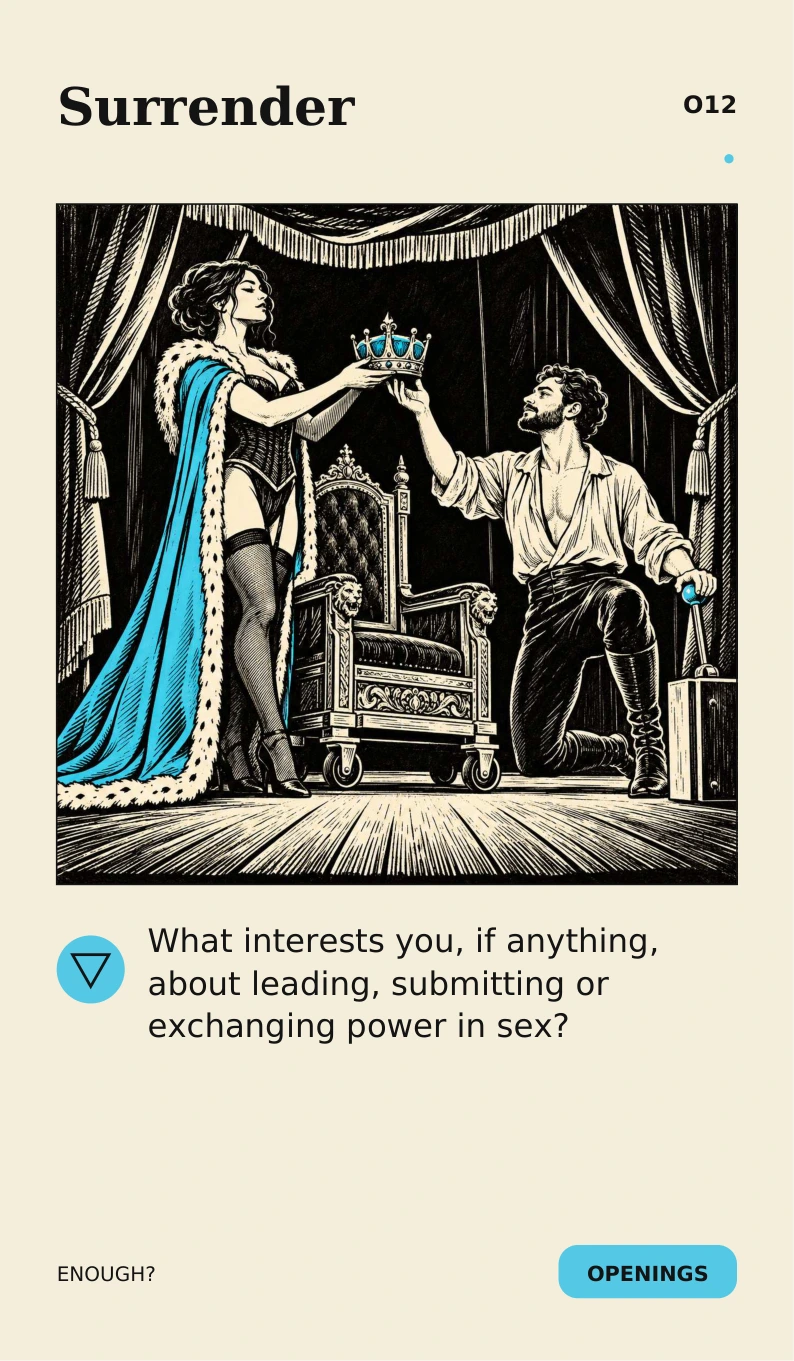
Five cards from the final deck. Select a card for a closer look.
The thinking behind the deck
The questions draw on Jung, the Enneagram, relationship anarchy and systems thinking. They give familiar experiences another angle—and something to discuss.
Jung’s ideas about persona, shadow and projection shape questions about the roles we inhabit, what we leave out of our self-image, and the meanings we give other people. The imagery leaves room for several interpretations.
The nine core patterns inform the first nine Strategy cards. Questions explore what helping, performing, protecting or keeping the peace might make possible—and what each response can crowd out. A card never assigns anyone a type.
Questions separate affection, commitment, sex, care and shared resources instead of assuming they come as one package. They make room to examine inherited expectations and discuss chosen agreements across friendships and other relationships.
Questions bring resources, ownership, rules and consequences into the conversation. They ask how an arrangement works, who sustains it, who can change it and what choices are materially available, alongside how it feels.
They’re influences on the questions and optional guidebook readings. You bring your experience. You can disagree with a reading, too.
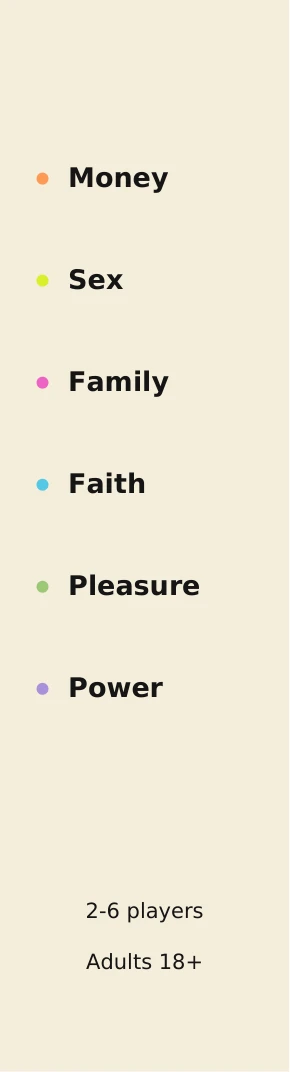
72 question cards · six suits
Money, shelter, bodies, time. What makes a life possible?
Family, success, being good. Who taught us what counts?
Helping, performing, protecting. How do we find our way?
Rest, play, desire, uncertainty. What could we make room for?
Friendship, care, jealousy, repair. How do our lives touch?
Ownership, consent, history. Who gets to change the terms?
Sex, faith and politics have a place here. Your group chooses which subjects belong in the evening.
How to play
Designed for 2–6 adults.
A proposed 30–90 minutes, or however long feels good.
Lay six face up. Draw two and pick one, or choose from the shared row.
Tell a story, name a pleasure or explore the question. Everyone stays in the shared conversation.
A question, a reflection or someone’s own story? The invitation cards help you say how you’d like people to join in.
Invite a different perspective if you want one. Then let someone else begin.
The first edition · in development
For dinner with friends, a weekend away or an evening with the people you live with.
A few things you might wonder
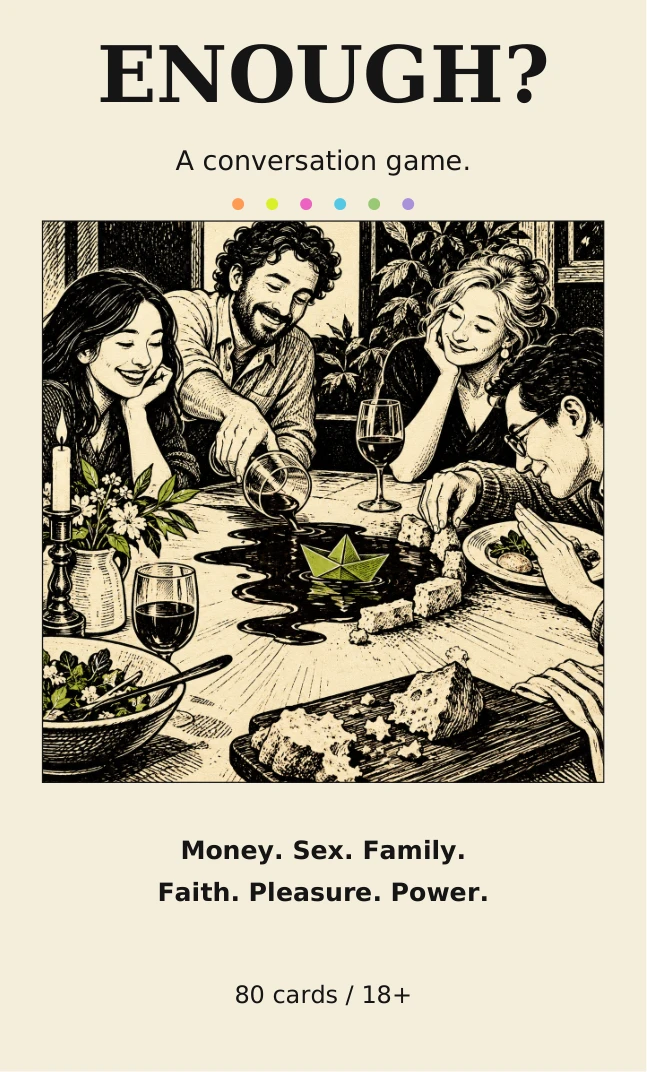
It’s a conversation game built around illustrated symbols and questions. Draw cards, tell stories and invite responses. You can also use the same deck for a longer reflective reading. No scoring or prediction is involved.
The deck questions work, worth, ownership and inherited expectations. Those concerns are part of it. Agreement with every question or reading isn’t required; disagreement can be a good place to begin.
You decide how much to share. A turn can stay with an ordinary memory, a made-up scene or something you enjoy. You can pass or change the card without explaining.
Yes. Selected cards ask directly about desire, pleasure, masturbation, consent and erotic power. Choose together whether sexual topics belong in the session. Cards start group discussion; they don’t pair players off or ask for sexual interaction.
No. Begin with the image and question. The guidebook is optional: it adds possible interpretations, further questions and longer ways to use the cards. Your own reading can differ.
The deck asks how work, worth, desire, belonging and power shape a life. It draws on Jung, the Enneagram, relationship anarchy and systems thinking, with further lenses in the guidebook. These influences shape how questions are framed: personal experience sits alongside inherited expectations, material conditions and the lives of other people.
The first nine Strategy cards draw on nine familiar Enneagram themes. They explore ways people seek safety, approval, autonomy or peace. You can recognize a response without identifying with a type. Drawing a card doesn’t tell anyone who they are.
Jung-inspired ideas make room to examine social roles, less acknowledged parts of ourselves and projection. Symbols can carry more than one meaning, depending on the reader and the situation. Interpretations remain possibilities; nobody gets to use a card to declare someone else’s hidden motives.
No. That influence opens questions about what people choose together and what they assume a relationship must contain. Friendship, commitment, care, desire and independence can be discussed on their own terms. The game doesn’t rank relationship structures.
Our choices take place within real arrangements. Housing, paid work, shared resources and decision-making affect what people can choose. Systems thinking keeps those conditions in view, so every difficulty doesn’t become a story about somebody’s personality.
It shares the experience of drawing illustrated cards and interpreting symbols. Here, the material is your own life, relationships and circumstances. Cards can be combined or read from different positions, but they don’t predict events or supply an authoritative answer.
No. You can question a premise, reject an interpretation or offer another reading when invited. These traditions are distinct influences, not one unified theory. No background knowledge or belief system is required to join the conversation.
No printed guidebook will be included. The expanded guidebook will be a free digital download, available separately from the physical deck. The cards and reference cards give you a way to start; the guide offers deeper readings when you want them. The download isn’t available on this page yet.
Expanded entries for the 72 symbolic cards, possible readings, further questions, the influences behind the deck and optional ways to arrange several cards for a longer conversation. You can consult one entry or explore a lens that interests you without reading it from beginning to end.
Not yet. The final illustrated deck is complete. Physical proofs, production costs and fulfilment need to be settled before orders open. The cards shown on this page are taken directly from that final deck.
ENOUGH?